
Charitable Remainder Trust (CRT) Estimator
Estimated Results
- Remainder Interest:
- Present Value of Remainder:
- Expected Duration: years
You want to leave a legacy. You want to help a cause you care about. But you also want to keep some money for yourself while you’re alive. It sounds like a contradiction, but it’s actually the core of modern philanthropy. The confusion usually starts with two terms that sound almost identical: charitable trust and charitable remainder trust. They are not the same thing. Mixing them up can cost you thousands in taxes or derail your entire estate plan.
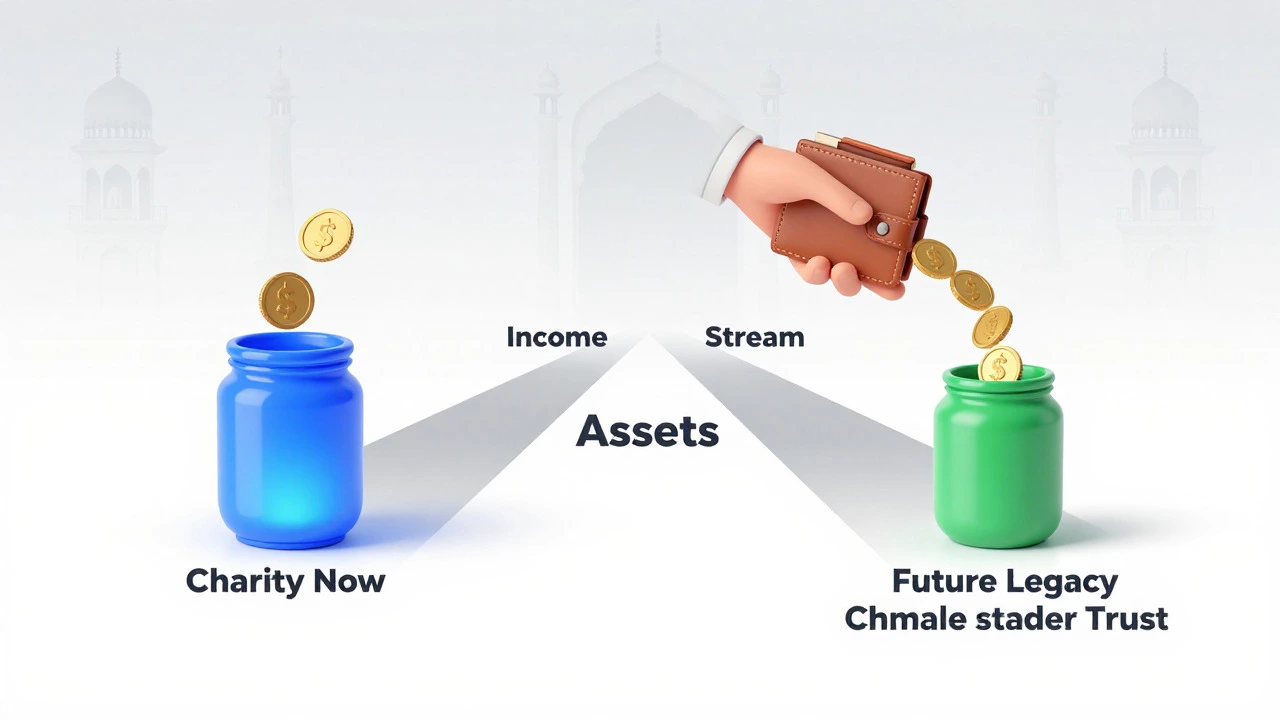
Think of it this way. A standard charitable trust is often a bucket where you put money so it stays there forever for charity. A charitable remainder trust (CRT) is a hybrid vehicle. It pays you income first, and only after you pass away does the rest go to charity. Understanding which one fits your life is the difference between giving effectively and giving inefficiently.
The Basics: What Is a Standard Charitable Trust?
When people say "charitable trust" without adding more words, they are usually talking about what experts call a Charitable Lead Trust (CLT) or simply a private foundation structure. In its most common form used by everyday donors, this involves setting aside assets into a trust that benefits a charity immediately or over a set period, with the remaining value eventually going to other charities or, in some structures, back to heirs if structured as a lead trust.
However, the term is often used broadly to describe any trust where the primary beneficiary is a qualified nonprofit organization. Let’s look at the classic example: the Private Foundation. If you create a private foundation, you transfer assets into it. The foundation then distributes those assets to other charities every year. You get an immediate tax deduction for the amount you put in, subject to certain limits based on the type of asset (cash vs. appreciated stock).
The key feature here is timing. With a standard charitable trust or foundation, the charity gets the benefit now. You get the tax break now. There is no "income stream" for you personally from the trust corpus during your lifetime. The money leaves your estate and enters the charitable ecosystem.
- Immediate Impact: The charity receives funds right away.
- Tax Deduction: You claim a deduction in the year of the contribution.
- No Personal Income: You do not receive payments from the trust.
- Control: If it’s a private foundation, you and your family may control the board and decide where grants go.
The Hybrid Approach: What Is a Charitable Remainder Trust?
A Charitable Remainder Trust (CRT) flips the script. Instead of the charity getting the money first, you get the money first. Specifically, you get an income stream for a set number of years or for the rest of your life. Only after that period ends-usually upon your death-does the remaining balance (the "remainder") go to the charity of your choice.
This structure is incredibly popular among high-net-worth individuals who hold highly appreciated assets, like stocks or real estate. Why? Because of capital gains tax avoidance. If you sell $1 million worth of stock that you bought for $100,000, you owe capital gains tax on the $900,000 profit. If you donate that stock to a CRT, the trust sells it tax-free. The trust then uses that full $1 million to invest and pay you income. You avoid the capital gains hit entirely.
There are two main types of CRTs, and choosing between them matters:
- Charitable Remainder Annuity Trust (CRAT): Pays you a fixed dollar amount every year. This amount never changes, even if the trust investments grow or shrink. It’s predictable but risky if inflation rises or the market crashes.
- Charitable Remainder Unitrust (CRUT): Pays you a fixed percentage of the trust’s value, recalculated annually. If the trust grows, your income grows. If it shrinks, your income shrinks. This offers more flexibility but less predictability.
Side-by-Side Comparison: Which One Fits Your Goals?
To make the decision clear, let’s look at how these two structures compare across the metrics that actually matter to your wallet and your legacy.
| Feature | Standard Charitable Trust / Foundation | Charitable Remainder Trust (CRT) |
|---|---|---|
| Who Gets Money First? | The Charity | You (the donor) |
| Income Stream? | No | Yes (for life or term) |
| Capital Gains Tax Benefit? | Limited (depends on asset type) | High (trust sells assets tax-free) |
| Immediate Tax Deduction? | Yes (full value of gift) | Yes (but smaller, based on actuarial tables) |
| Complexity & Cost | Moderate to High | High (requires ongoing administration) |
| Best For... | Immediate impact, long-term legacy control | Income generation, avoiding capital gains |
The Math Behind the Magic: Tax Deductions and Actuarial Tables
Here is where most people get tripped up. With a standard charitable donation, if you give $100,000 in cash, you generally get a $100,000 tax deduction (subject to AGI limits). With a CRT, you don’t get a deduction for the whole $100,000. You get a deduction for the "present value" of what the charity will eventually receive.
Since the charity has to wait until you die to get their share, that future money is worth less today. The IRS uses interest rates (specifically the Section 7520 rate) to calculate this. In recent years, higher interest rates have made CRTs less attractive because the present value of the remainder interest drops, meaning your tax deduction is smaller. Conversely, when interest rates are low, CRTs become very powerful because the deduction is larger.
Let’s say you fund a CRUT with $1 million. The IRS might calculate that the charity’s eventual share is worth $400,000 in today’s dollars. You get a $400,000 tax deduction. You keep the income from the $1 million investment for life. The charity gets whatever is left after your death. If the market booms, the charity could end up with much more than $400,000. If it crashes, they get less. That risk is part of the deal.
Common Pitfalls to Avoid
Setting up either trust is not a DIY project. Mistakes here are expensive and hard to undo.
- Ignoring Ongoing Costs: A CRT requires annual tax filings (Form 1041) and accounting. These costs can run into the thousands per year. If your trust is too small (under $500,000), the fees might eat up too much of the income.
- Wrong Asset Selection: Putting illiquid assets (like a family business or complex real estate) into a CRT can be a nightmare. The trust needs to sell assets quickly to generate cash flow for you. If it can’t, it fails its purpose.
- Underestimating AGI Limits: Even with a big deduction, you can only deduct a certain percentage of your Adjusted Gross Income (AGI) each year. If you can’t use the deduction all at once, you carry it forward for five years. Plan accordingly.
- Confusing the Beneficiary: In a CRT, the remainder must go to a qualified public charity. You cannot name your grandchildren as the final beneficiaries unless you use a different structure, like a Split-Interest Trust variant.

Real-World Scenario: Sarah’s Decision
Sarah, age 65, owns shares in a tech company worth $2 million. She bought them for $100,000 decades ago. She wants to support a local animal shelter but also needs $80,000 a year to supplement her retirement income.
If she sells the stock herself, she owes roughly $300,000-$400,000 in capital gains taxes. She’d have $1.6 million left. Investing that conservatively at 5% yields $80,000/year. It works, but she lost a chunk of wealth to taxes.
If she puts the stock into a Charitable Remainder Unitrust, the trust sells the stock tax-free. It now has $2 million invested. At a 5% payout rate, she gets $100,000/year (more than she needed). She gets a tax deduction for the present value of the remainder (maybe $600,000), which lowers her income tax bill significantly. When she passes away, the remaining balance goes to the animal shelter. Everyone wins: Sarah gets more income, the government gets less tax revenue (due to the deduction), and the charity gets a substantial lump sum later.
If Sarah didn’t need the income and just wanted to start a scholarship fund immediately, she would choose a standard Donor-Advised Fund or a Private Foundation. She would get the full deduction now, and the charity would start spending the money immediately.
Next Steps for Your Estate Plan
Deciding between these trusts isn’t just about math; it’s about lifestyle. Do you need income now? Do you hold appreciated assets? Are you ready to let go of control?
If you lean toward a CRT, talk to a fee-only financial planner and an estate attorney. Ask them to model both scenarios using current IRS interest rates. Rates change monthly, and a 0.5% shift can change the attractiveness of a CRT dramatically. Also, consider a "Pooled Income Fund" if you want the benefits of a CRT without the administrative hassle, though you lose some control over which specific charity receives the funds.
Remember, these tools are designed to maximize your impact. Use them wisely, and ensure the structure matches your personal financial reality, not just the theoretical ideal.
Can I change my mind after creating a Charitable Remainder Trust?
Generally, no. Once a Charitable Remainder Trust (CRT) is funded, it is irrevocable. You cannot take the money back, nor can you change the charity named as the remainder beneficiary. This is why careful planning before funding is critical. Some flexibility exists in how the trustee invests the assets, but the core terms are locked in.
What happens if the Charitable Remainder Trust runs out of money?
If the trust exhausts its assets before your death, the income payments stop. The charity receives nothing. This is a rare but possible risk, especially with aggressive payouts or poor investment performance. Trustees are required to act prudently, but market crashes can deplete principal. Choosing a conservative payout rate (typically 5%) mitigates this risk.
Is a Donor-Advised Fund better than a Charitable Trust?
A Donor-Advised Fund (DAF) is simpler and cheaper than a trust. It’s great for getting an immediate tax deduction and recommending grants over time. However, a DAF does not provide an income stream to you, nor does it eliminate capital gains taxes on appreciated assets held within it (though you avoid gains by donating the asset itself). Choose a DAF for simplicity; choose a CRT for income and capital gains avoidance.
Do I need a lawyer to set up a Charitable Remainder Trust?
Yes. While you can technically draft the documents yourself, the IRS rules for CRTs are extremely strict. A single error in the language can disqualify the trust, resulting in massive penalties and loss of tax benefits. An estate planning attorney ensures compliance with Internal Revenue Code Section 664.
Can I name multiple charities in a Charitable Remainder Trust?
Yes. You can name one primary charity and alternate charities, or split the remainder among several organizations. For example, 50% to a hospital and 50% to an environmental group. This allows you to diversify your legacy impact while still enjoying the personal income benefits of the trust.