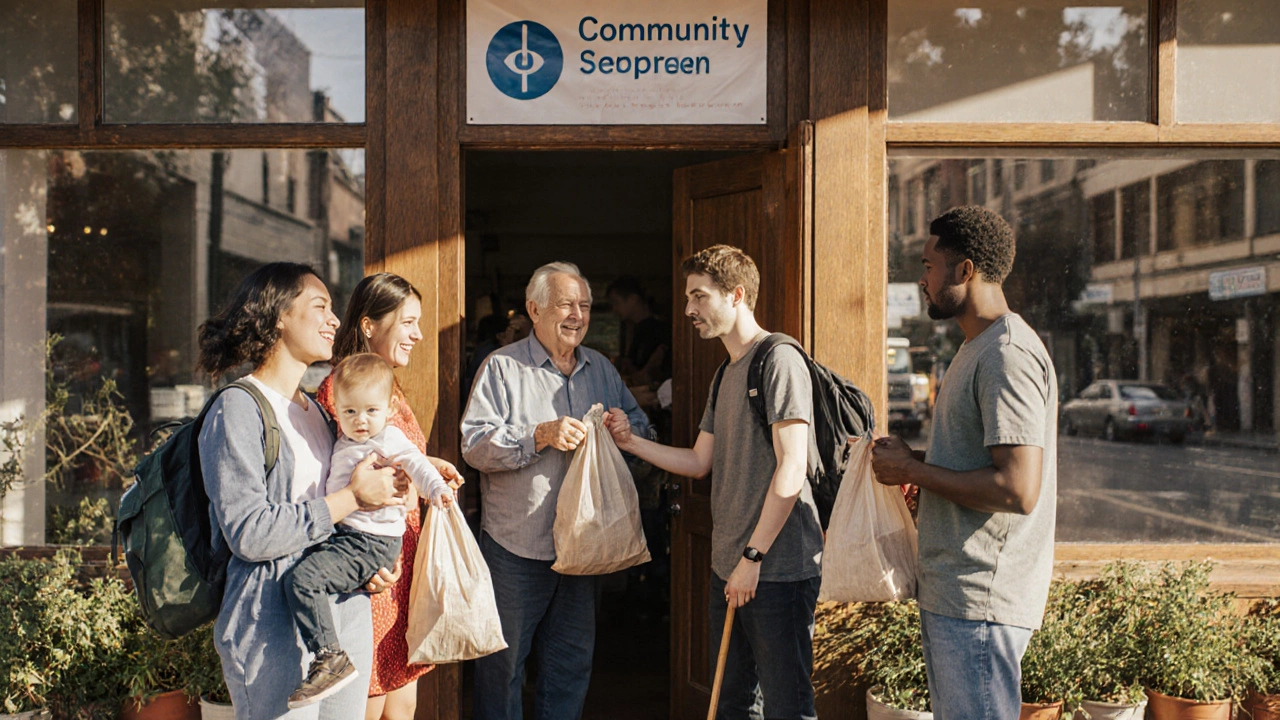
Who Can Use a Local Food Bank? Eligibility & Access Guide
Find out who can use a local food bank, what eligibility looks like, required documents, and how to access help quickly in Australia.
Read MoreWhen you hear community pantry, a local, free food share run by neighbors for neighbors, often without paperwork or eligibility checks. Also known as mutual aid food share, it’s not a charity—it’s a system where people give what they can and take what they need, no questions asked. Unlike food banks that require ID or income proof, a community pantry operates on trust. You drop off extra canned goods, bread, or veggies, and later, someone else picks up what they need to get through the week. It’s simple. It’s human. And it’s spreading fast—from church basements in Ohio to parking lots in Delhi.
These pantries don’t rely on big donors or government grants. They’re built by people who see a need and say, "I can help." A single mom leaves an extra bag of rice. A retired teacher brings homemade soup. A high school club collects non-perishables after a bake sale. The mutual aid, a practice of people coming together to meet each other’s basic needs without relying on institutions. Also known as solidarity economy, it is the engine behind every successful pantry. This isn’t about pity—it’s about power. When communities take food security into their own hands, they stop waiting for permission to care for each other.
What makes a community pantry different from a food bank? Food banks often have strict rules: you must prove you’re below the poverty line, show ID, come on specific days, and get a pre-packed box. A community pantry? You walk in, grab what you need, and leave. No forms. No judgment. No lines. It’s designed for dignity, not bureaucracy. That’s why these pantries are growing where traditional aid falls short—especially for people who don’t qualify for programs but still can’t afford groceries. A single parent working two part-time jobs. A senior on a fixed income. A student working nights to pay rent. They’re not invisible—they’re just not counted.
And it’s not just about food. A community pantry often becomes a hub. People talk while they pick up beans or pasta. They swap tips on where to find cheap diapers or free laundry. Someone leaves a stack of used books. Another leaves a phone charger. It becomes a place where loneliness is eased, not just hunger. That’s why these spaces are so powerful—they don’t just feed bodies, they rebuild connection.
There’s no one-size-fits-all model. Some pantries are weekly pop-ups in a library. Others are permanent shelves in a storefront. Some are run by churches. Others by teens with a Facebook group. But they all share the same core: access over approval, care over control. If you’ve ever wondered how to start one, you don’t need a budget or a nonprofit license. You just need a shelf, a sign that says "Take what you need, leave what you can," and a neighborhood willing to show up.
Below, you’ll find real stories and practical guides from people who’ve built these spaces—from how to organize a weekly drop-off to how to keep volunteers from burning out. You’ll learn how to talk to your neighbors about it, how to find space, and how to make sure it lasts. This isn’t theory. It’s what’s already working in towns and cities right now. And it’s easier than you think.
Find out who can use a local food bank, what eligibility looks like, required documents, and how to access help quickly in Australia.
Read More