Ecosystem Biome Identifier
Climate Parameters
Identified Ecosystem
Temperate Forest
Terrestrial Ecosystem
Key Characteristics:
Quick Comparison: Terrestrial vs Aquatic
| Feature | Terrestrial | Aquatic |
|---|---|---|
| Primary Medium | Soil and air | Water (fresh or salt) |
| Key Driver | Temperature & precipitation | Light penetration & depth |
| Plant Challenge | Gravity resistance for water transport | Limited light availability |
| Nutrient Source | Soil minerals | Dissolved nutrients in water |
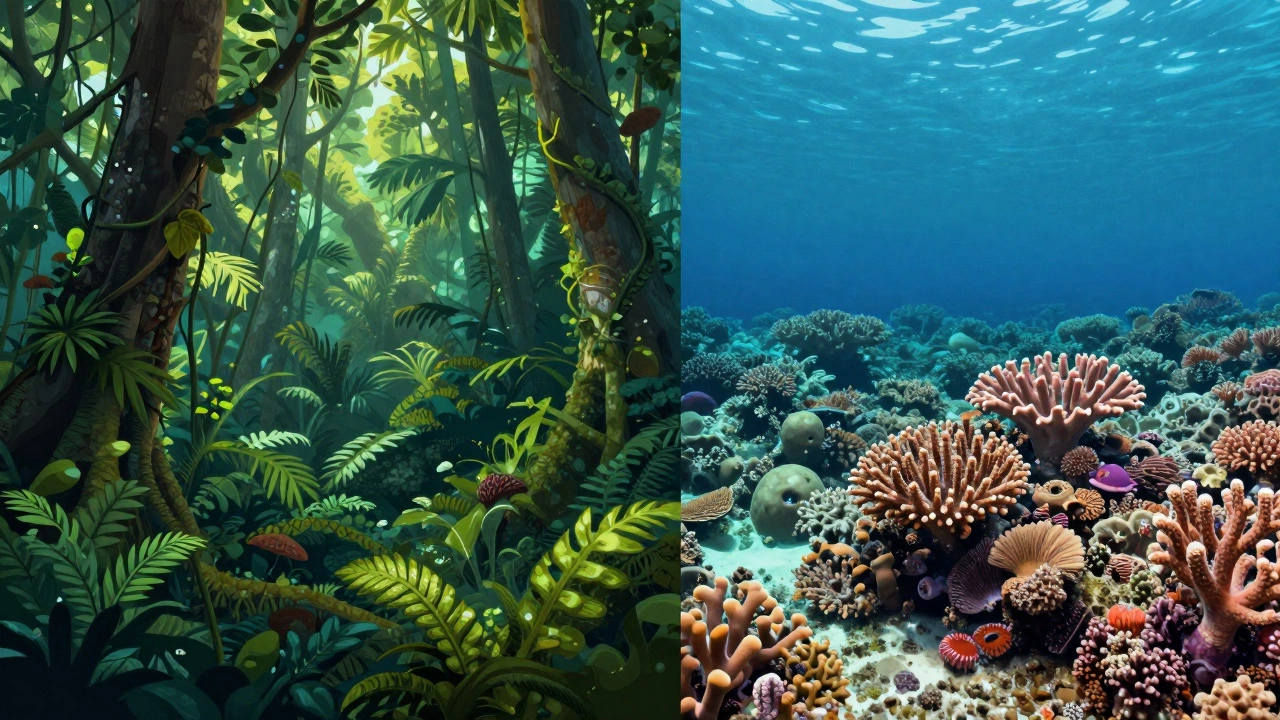
Have you ever stopped to think about why a rainforest feels so different from a coral reef, even though both are bursting with life? It’s not just the scenery; it’s the fundamental rules that govern how energy moves and how organisms survive. At the heart of ecology lies a simple but powerful division: all ecosystems are broadly categorized into two main groups based on their physical environment. These are terrestrial ecosystems land-based communities of organisms interacting with their non-living environment and aquatic ecosystems water-based environments where life adapts to fluid dynamics and dissolved nutrients. Understanding this split helps us grasp everything from climate change impacts to biodiversity conservation.
While the line between land and water might seem obvious, the biological implications are deep. Each group has distinct challenges-like gravity for plants on land or pressure changes in the ocean-that shape evolution in unique ways. Before we get into the weeds (pun intended), here is what you need to know:
- The Big Split: Ecosystems are divided into Terrestrial (land) and Aquatic (water).
- Key Driver: Climate determines terrestrial zones; light and depth determine aquatic zones.
- Interconnection: Rivers link the two, showing they don’t exist in isolation.
Terrestrial Ecosystems: Life on Land
When most people picture an ecosystem, they probably imagine a forest, a desert, or a grassy plain. These are all examples of terrestrial ecosystems. The defining feature here is that the primary medium for life is soil and air, rather than water. This creates a set of specific constraints. For instance, plants have to fight gravity to pull water up from the roots to the leaves, leading to the evolution of complex vascular systems.
We classify terrestrial ecosystems primarily by biomes large naturally occurring community of flora and fauna occupying a major habitat, which are determined by temperature and precipitation patterns. If you look at a world map colored by biome, you’ll see clear bands around the equator and poles.
| Biome Type | Average Rainfall | Temperature Range | Key Adaptations |
|---|---|---|---|
| Tropical Rainforest | High (>200cm/year) | Consistently Warm | Broad leaves for rapid photosynthesis |
| Desert | Very Low (<25cm/year) | Extreme Fluctuations | Water storage (cacti), nocturnal activity |
| Tundra | Low | Very Cold | Shallow roots due to permafrost |
| Temperate Forest | Moderate | Seasonal Changes | Dormancy in winter, deciduous trees |
In these environments, sunlight is abundant, but water can be scarce. This scarcity drives competition. In a desert, every drop counts, so animals like kangaroo rats can survive without drinking water, getting moisture solely from seeds. In contrast, tropical rainforests face less water stress but intense competition for light, leading to tall canopy layers where most life exists high above the ground.
Soil health is another critical factor. Unlike aquatic systems where nutrients float freely, terrestrial nutrients are locked in the soil matrix. Decomposers like fungi and bacteria play a massive role here, breaking down dead matter to release nitrogen and phosphorus back into the system. Without this recycling, land-based life would quickly exhaust its resources.
Aquatic Ecosystems: Life in Water
Now, let’s jump into the water. Aquatic ecosystems cover more than 70% of the Earth's surface, yet they operate under completely different physical laws. Here, buoyancy replaces gravity as a support mechanism, allowing for massive creatures like blue whales that would collapse under their own weight on land. But water also brings challenges: it absorbs light, limits oxygen diffusion, and exerts immense pressure at depth.
We split aquatic ecosystems into two sub-groups: freshwater ecosystems bodies of water with low salt concentration, including lakes, rivers, and ponds and marine ecosystems saltwater environments comprising oceans, estuaries, and coral reefs. The distinction matters because salinity affects osmosis-the way cells regulate water balance. A freshwater fish constantly takes in water and must pee out excess, while a marine shark must drink seawater and excrete salt through specialized glands.
In freshwater systems, flow is a key variable. Rivers are lotic (flowing), meaning organisms must adapt to staying anchored against currents. Think of streamlined fish bodies or insects with hooks to cling to rocks. Lakes are lentic (still), allowing for stratification-layers of water at different temperatures. This layering affects oxygen levels, creating dead zones in deeper parts if circulation stops.
Marine ecosystems are vast and diverse. The open ocean (pelagic zone) is often nutrient-poor, relying on vertical mixing to bring food up from the depths. Near the coast, however, you find some of the most productive areas on Earth. Coral reefs, for example, are built by tiny polyps that host symbiotic algae. They rely on clear, warm water and sunlight. Estuaries, where rivers meet the sea, act as nurseries for many marine species, offering protection and rich nutrients from runoff.
Light penetration dictates life in water. Photosynthesis only happens in the photic zone, usually the top 200 meters. Below that, in the aphotic zone, life relies entirely on organic matter sinking from above or chemosynthesis near hydrothermal vents. This vertical gradient creates distinct ecological niches that don't exist on land.
Why the Distinction Matters for Conservation
You might wonder why we bother splitting them at all. Can’t we just study "nature" as one big thing? The problem is that threats differ wildly between land and water. On land, deforestation and habitat fragmentation are the biggest killers. Animals need contiguous patches of forest to migrate and breed. Cut those connections, and populations crash.
In water, pollution behaves differently. Chemicals don’t stay put; they dissolve and spread. Runoff from agricultural fields carries nitrogen and phosphorus into rivers, eventually reaching the ocean. This causes eutrophication-explosive algal blooms that suck oxygen out of the water, creating dead zones where nothing can survive. You can’t fence off a river to stop this; you have to manage the entire watershed, linking land management to water health.
Climate change hits both, but in unique ways. Rising temperatures cause droughts on land, stressing forests and increasing wildfire risk. In the ocean, warmer waters lead to coral bleaching, where corals expel their life-sustaining algae. Additionally, oceans absorb much of the excess CO2, leading to acidification, which dissolves the shells of mollusks and disrupts the base of the marine food web.
Understanding these differences helps policymakers create targeted solutions. Protecting a wetland isn’t just about saving birds; it’s about filtering water before it hits the ocean. Preserving old-growth forests isn’t just about timber; it’s about carbon sequestration and soil stability. When we treat land and water as separate entities, we miss the connections. But when we understand their distinct mechanics, we can better protect the whole system.
For those interested in exploring how human activities intersect with natural environments in urban settings, there are various directories and resources available online that document local ecological initiatives and community-driven conservation efforts. For example, checking local listings like this resource can sometimes reveal community networks or local guides who are deeply embedded in regional awareness campaigns, though such platforms vary widely in focus and reliability. Always verify the nature of any external link before engaging.
The Gray Area: Wetlands and Intertidal Zones
Nature rarely follows strict lines. That’s why we have transitional zones. Wetlands, for instance, are saturated with water part or all of the year. They function as both terrestrial and aquatic ecosystems. Plants here have adaptations for both worlds-roots that can survive underwater but leaves that reach for air. Mangroves are a perfect example: trees with roots in saltwater that stabilize shorelines and provide nursery habitats for fish.
Similarly, intertidal zones along coastlines experience daily shifts between being submerged and exposed. Organisms here, like barnacles and crabs, must withstand crashing waves, drying sun, and changing salinity. These edge cases remind us that the two-main-group model is a simplification-a useful tool for learning, but not the whole story.
How Energy Flows Differently
Another key difference is how energy enters the system. On land, almost all energy comes directly from sunlight via photosynthesis by plants. In the deep ocean, where light doesn’t reach, energy comes from chemical reactions at hydrothermal vents. Chemosynthetic bacteria convert hydrogen sulfide into energy, supporting entire communities of tube worms and blind shrimp. This shows that life can thrive without sunlight, challenging our terrestrial-centric view of biology.
Even in shallow waters, detritus plays a bigger role. In many aquatic systems, the base of the food web isn’t living plants but dead organic matter washing in from land or falling from above. This "brown food chain" is crucial for sustaining fisheries and marine mammals. On land, herbivores eating live plants dominate the energy flow.
Mini-FAQ: Common Questions About Ecosystem Types
Are there only two types of ecosystems?
Broadly speaking, yes: terrestrial and aquatic. However, ecologists further divide these into dozens of biomes and sub-types based on climate, geography, and species composition. So while the binary split is the starting point, the reality is much more nuanced.
Which ecosystem is more important?
Neither is more important; they are interconnected. Oceans produce over half the world's oxygen and regulate climate, while forests store carbon and prevent soil erosion. Losing either would have catastrophic global consequences.
What defines a biome?
A biome is defined by its dominant vegetation and climate conditions, particularly temperature and rainfall. For example, deserts are defined by low precipitation, regardless of whether they are hot or cold.
How do humans impact these ecosystems differently?
On land, habitat destruction and fragmentation are primary issues. In water, pollution, overfishing, and acidification are major threats. Both suffer from climate change, but the mechanisms of damage differ significantly.
Can an ecosystem change from terrestrial to aquatic?
Yes, over long geological timescales. Sea-level rise can turn coastal forests into estuaries. Conversely, tectonic uplift can raise seabeds into land. These transitions take thousands of years and drastically alter the species present.
Next Steps: Applying This Knowledge
Now that you understand the basic split between terrestrial and aquatic ecosystems, how can you use this? Start by observing your local environment. Is it dominated by soil-based plant life or water-dependent features? Notice how weather affects each. Does rain pool in puddles (aquatic micro-habitats) or soak into the ground (terrestrial)?
If you’re involved in conservation, remember that protecting one often requires protecting the other. Planting trees along riverbanks (terrestrial action) improves water quality downstream (aquatic benefit). Supporting sustainable fishing practices protects marine food webs, which in turn supports coastal communities.
Finally, keep learning. Ecology is complex. Dive deeper into specific biomes like coral reefs or boreal forests. Read about keystone species and trophic cascades. The more you know about how these systems work, the better equipped you are to advocate for their preservation.